


 (+91) 80 4566 6666
  (+91) 7022316664
  Emergency: (+91) 80 4566 6616





Posted on : 16/02/2026 Views : 11012
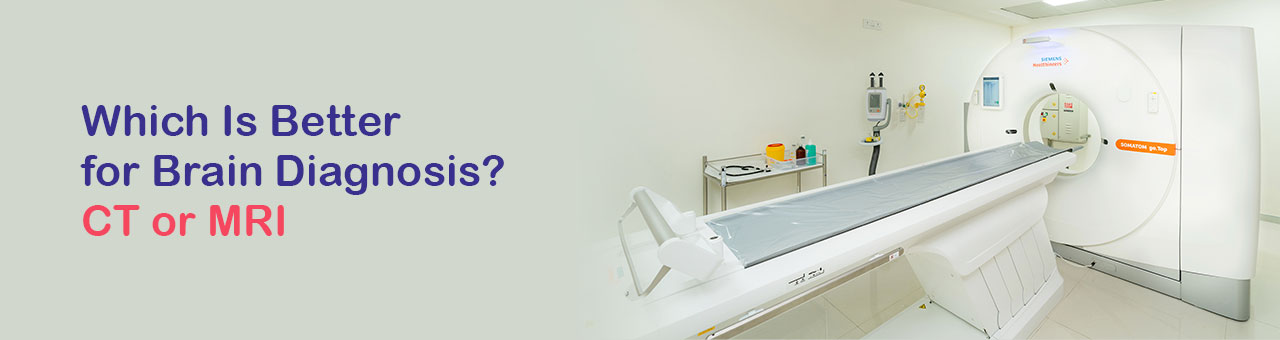
Which Is Better for Brain Diagnosis? CT or MRI
When it comes to addressing any issue related to the brain, diagnosis plays a huge role. CT and MRI are two very well-known tools in brain diagnosis. However, which is better, CT or MRI for the brain? The right choice depends on symptoms, urgency, and expert medical judgment.
Introduction
Neurological conditions are best diagnosed by studying brain imaging. The two most popular and commonly used diagnostic techniques are CT and MRI. While both are powerful tools, their effectiveness depends on the clinical situation. This article simplifies the decision CT SCAN vs MRI brain by presenting a side-by-side comparison, answering common patient questions, and explaining how specialists make that all-important decision.
Choosing between CT and MRI for brain diagnosis depends on the complexity of the condition and the level of detail in which the diagnostic tests need to be conducted. While CT scans are fast and ideal for emergencies like trauma or bleeding, MRI offers superior soft-tissue clarity, making it the preferred choice for identifying tumours, nerve disorders, and chronic brain conditions.
CT vs MRI for Brain Diagnosis
| Feature | CT scan | MRI |
| Technology | X-ray and computer processing | Magnetic field and Radioactive rays |
| Duration | Quick (5-10 minutes ) | Longer (15-25 minutes) |
| Best recommended for | Head injury, brain bleeding, fractures, emergency stroke evaluation | Brain tumours, infections, epilepsy, multiple sclerosis, nerve damage |
| Radiation exposure | Yes, but I a low dosage | No radiation |
| Emergency application | Preferred as first line approach | Rarely used in emergencies |
| Tumer detection | Detects large masses | Highly superior and specific |
| Stroke identification | Rules out haemorrhage quickly | Accurate and early detection of ischemic stroke |
| Cost | Low cost | High cost |
| Availability | Widely available | Limited availability |
| Patient limitations | Suits all types of patients | Not recommended for patients with pacemakers and mental health issues. |
CT and MRI: How Significant Is Exposure and Evidence-Based Report?
- Accurately interpreting brain scans may require considerable focus and exposure. Radiologists with adequate experience can identify variations and early disease signs, reducing diagnostic errors.
- Nice technology-driven MRI techniques—such as diffusion imaging, contrast-enhanced scans, and functional MRI—require in-depth, specific training.
- International medical guidelines recommend CT for acute neurological emergencies and MRI for detailed brain analysis. Hospitals that follow evidence-based protocols ensure appropriate test selection.
- Transparent reporting, updated equipment, patient safety standards, and clear communication build the all-important bond between the patient and the hospital. When patients understand why a CT or MRI is recommended, confidence in diagnosis improves.
This article gives a simple and clear difference when it comes to choosing between CT and MRI for brain diagnosis. It leads by example as it answers real patient questions, incorporates and reflects how modern hospitals actually use CT and MRI in clinical practice.
Conclusion
Choosing CT or MRI for diagnosing an issue with the brain can sometimes be a more taxing affair. Staying aware of the differences between the two can be of good help. Speak with the diagnostic specialists at United Hospital, where advanced imaging technology and expert interpretation combine to deliver fast, accurate, and reliable brain diagnosis—when it matters most.
FAQs
- Is MRI more accurate than CT for brain diagnosis?
Yes. MRI provides in-depth analysis of brain tissues, making it more accurate for tumours, inflammation, and neurological conditions. - Which is safer: CT or MRI?
MRI is safer in terms of radiation exposure, as it uses none. Though CT scans use radiation, it is recommended only when medically necessary and at a low dosage. Hence, CT scans are also safe. - Can a CT scan miss brain problems?
Yes, it is possible, as when it comes to identifying small tumours, early strokes, or subtle nerve damage, a CT scan is not as efficient as an MRI. - Why is CT done first in emergencies?
CT is faster, widely available, and excellent for detecting life-threatening bleeding or fractures. Hence, it continues to be the first choice, especially during emergencies. - Is an MRI always required for brain diagnosis?
No. MRI is used when detailed imaging is required. Many conditions are accurately diagnosed using CT alone.
References
- Mayo Clinic – CT Scan vs MRI
- Cleveland Clinic – MRI vs CT Imaging
- Radiology Info (ACR/RSNA) – Brain Imaging Tests
- Harvard Health Publishing – Choosing Medical Imaging
- Johns Hopkins Medicine – CT or MRI for Neurological Disorders